 DESIGN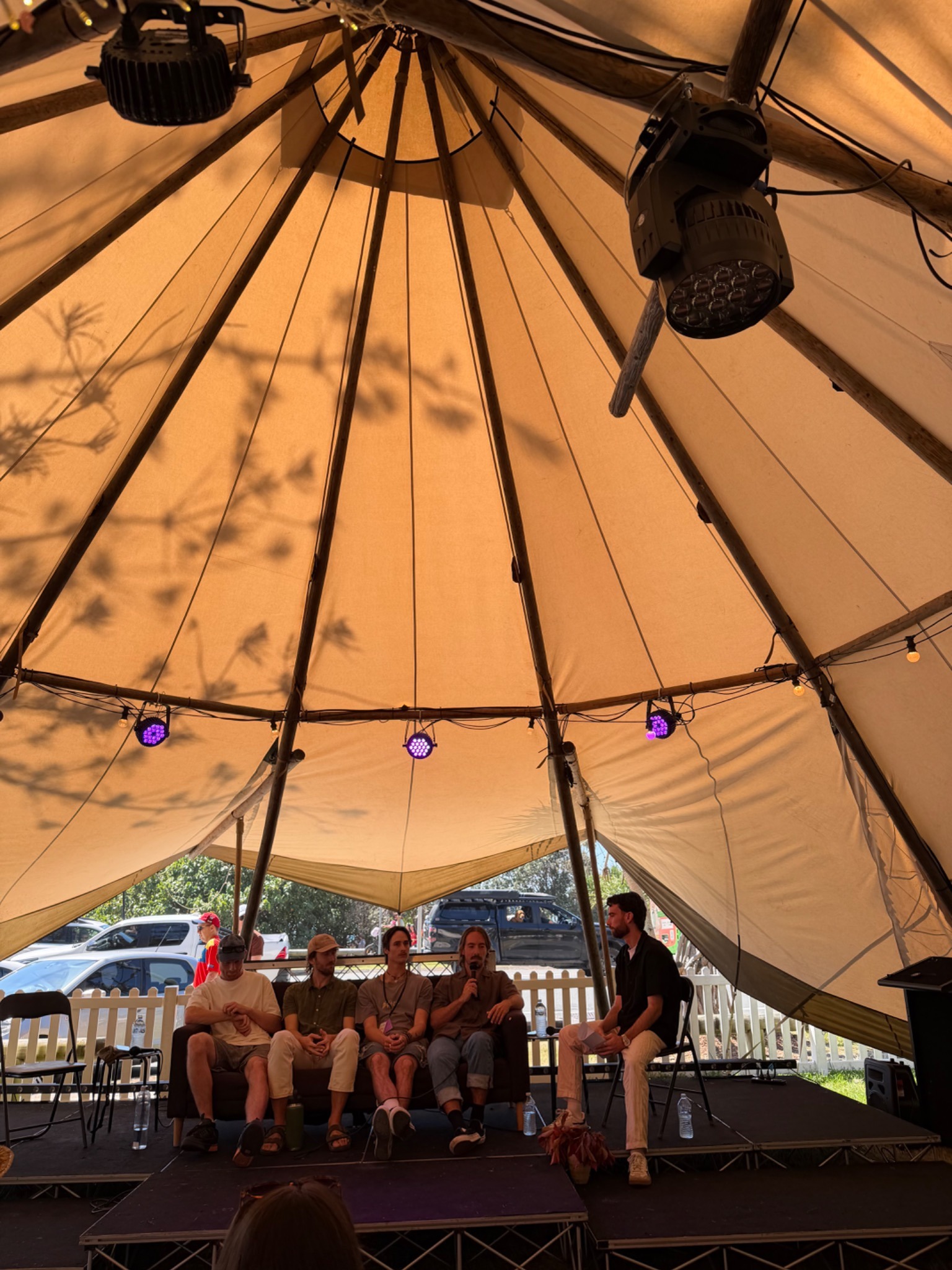
A reflection on the questions behind a SWELL panel: what architecture and art can learn from one another, why making matters, and how looking back might help us move forward.
Where does a building end and a work of art begin? The question sounds straightforward until we try to draw the line. A sculpture can create a place to gather. A building can carry an idea far beyond its practical use. A material, an opening or a change in light can turn an ordinary encounter into something we remember.
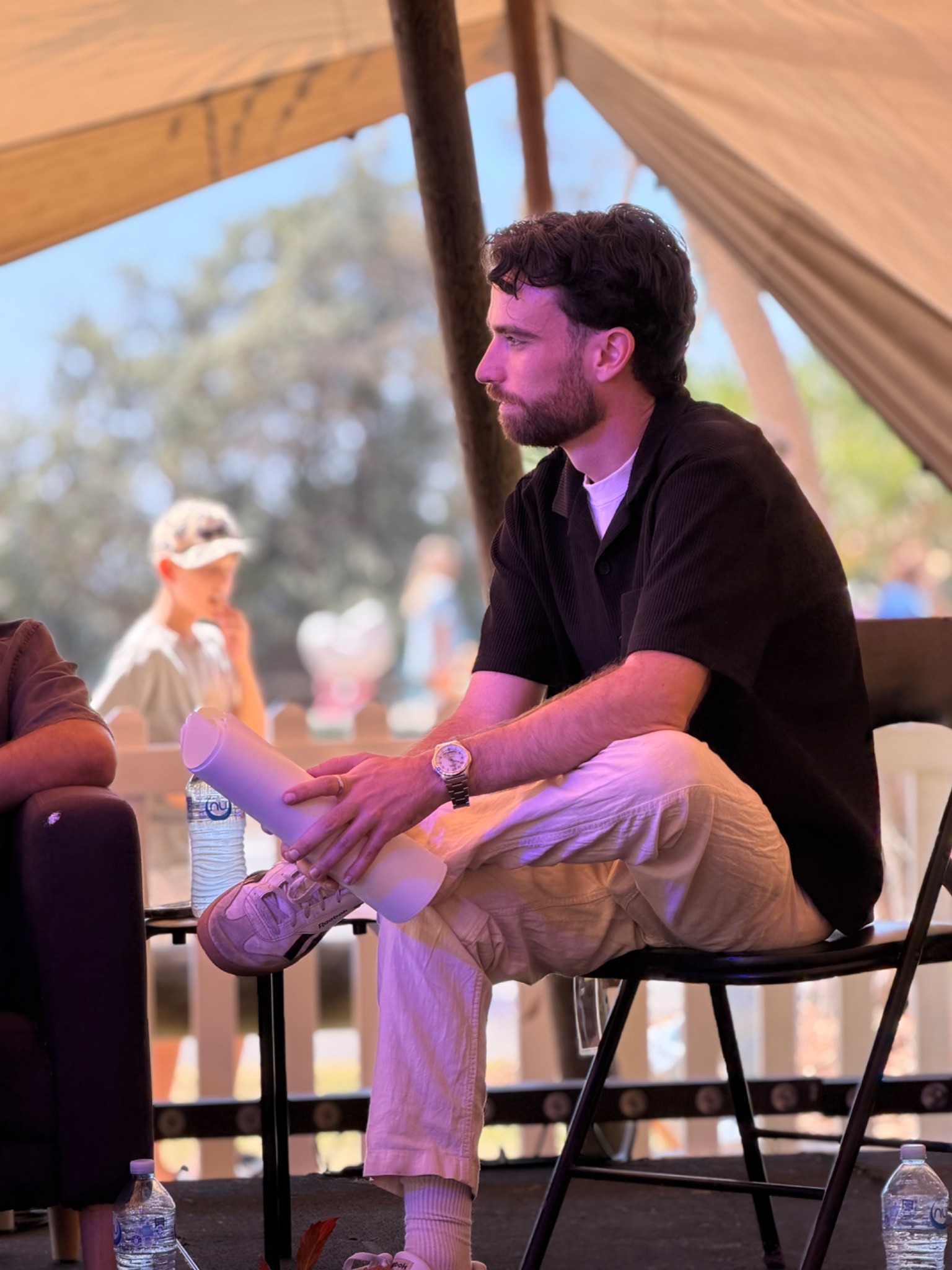
Between Building and Art, the panel I hosted during SWELL Sculpture Festival, grew out of an interest in that overlap. Bringing together Ajay Thomas, Reuben Mergard, Phil Darnton and Brent Grainger, it offered a starting point for thinking across creative practices rather than treating them as separate worlds.
This post develops the questions behind the panel and my own reflections on them. It is not a transcript or a record of individual speakers’ answers. The interest lies in keeping the enquiry open: what becomes possible when people who think through spaces, images, structures and objects share a conversation?
Before the categories, there is an experience
Architecture and art are familiar words, but they do not necessarily mean the same thing to everyone. One person might understand architecture through shelter and construction; another through atmosphere, memory or the way people occupy a place. Art might begin with expression, a question, a material experiment or an invitation to look more closely.
These definitions matter because they shape what we allow a project to become. If we approach a sculpture only as an object to look at, we may miss the space around it. If we approach a building only as a practical arrangement, we may overlook its emotional or cultural presence.
For me, the useful starting point is the encounter itself. What does someone notice? Do they pause, enter, look up or move around? What changes when they experience the work with other people? These questions can be asked of a temporary installation just as readily as a room, a courtyard or a public space.
A festival as a place to test ideas
SWELL provides a particularly interesting setting for this discussion because the works sit within a landscape that is already being used. Visitors arrive with different interests and levels of familiarity with art. Some seek out a particular sculpture; others come across it while walking. The work has to meet people in that everyday setting.
That encounter asks more of a sculpture than a single image can explain. Its scale changes as you approach. Light and weather alter its surfaces. The ground, the horizon and nearby activity become part of its context. A work might frame a view, interrupt a familiar route or invite a moment of attention.
This is where the conversation becomes spatial. Even without enclosing a room, an artwork can influence movement, establish a threshold or give a particular patch of landscape a new identity. Those effects offer common ground for artists and people working with the built environment.
Littoral Lantern: thinking through light and material
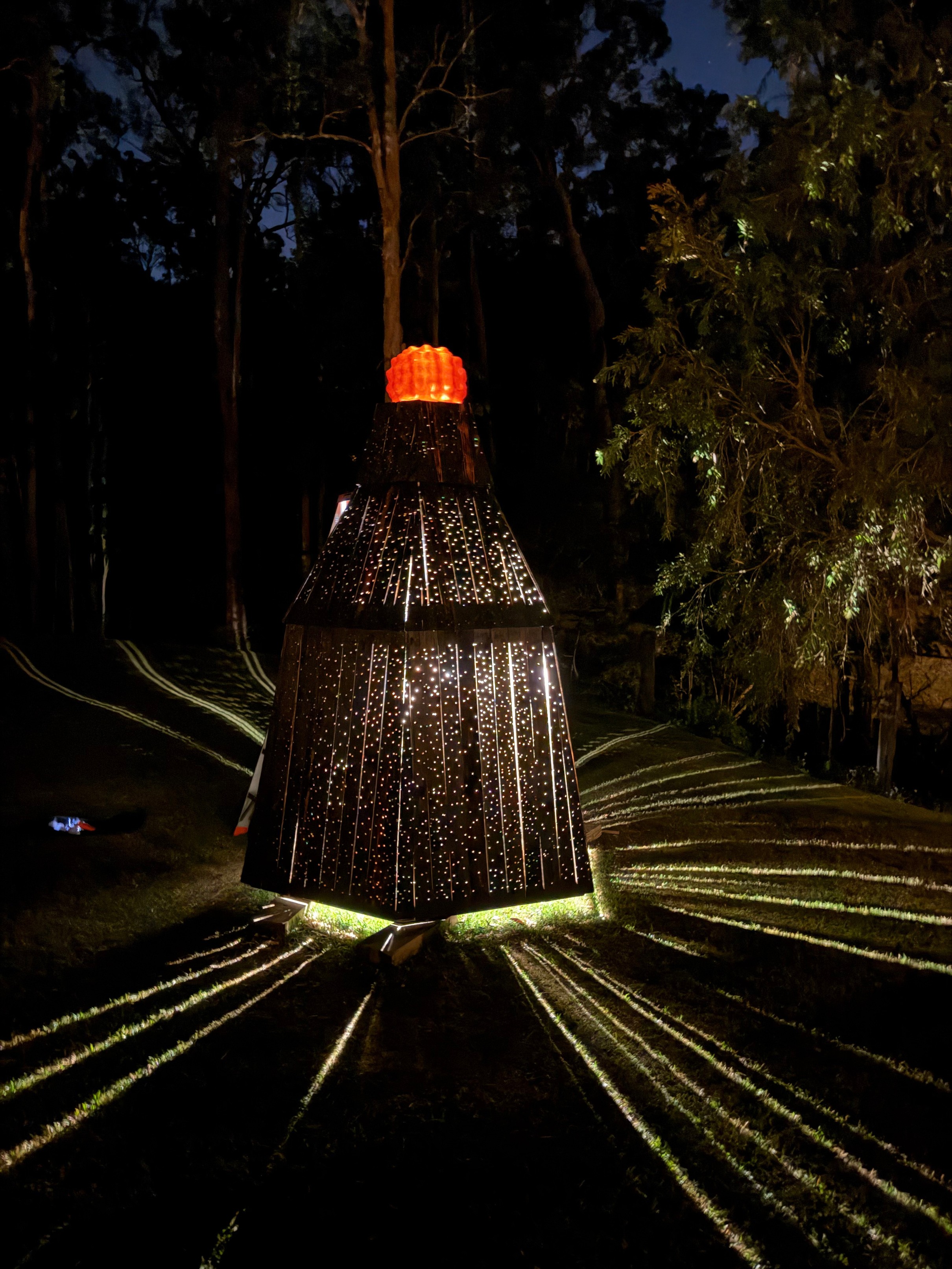
Making Littoral Lantern with Brent Grainger gave these questions a practical setting. Drawing on the coastal pandanus, its roots and seed pod, we developed a tiered timber form with an illuminated shade above it. The project brought together sculpture, an interest in structure and the experience of light.
What interested me was not simply how the sculpture would appear from a distance. It was also how someone might approach it, read the timber surfaces and discover the relationship between the outer form and the light within. The openings and gaps were part of that experience: they allowed the material to become a filter rather than just a boundary.
There is a difference between describing those intentions and making them tangible. A drawing can establish a direction, but construction introduces resistance. Connections need to work. Repetition needs to be managed. Materials have their own behaviour. The finished experience emerges through those decisions, not separately from them.
What making teaches that an image cannot
Creative work is often communicated through a finished photograph or render. Those images are useful, but they can make the process seem much more certain than it was. The awkward tests, material limitations and small adjustments disappear.
Hands-on making brings them back into focus. Timber is no longer just a colour on a screen: it has weight, grain, moisture and variation. A joint is no longer just a line: it has a sequence of assembly and a relationship to the person building it. A repeated element can be simple on its own and demanding across an entire structure.
That does not make digital work less valuable. It suggests a productive exchange. Drawing and modelling help us anticipate, compare and communicate. Physical tests reveal what we have misunderstood or not yet considered. Moving between the two can sharpen the idea.
The same exchange can happen between disciplines. An artist’s willingness to test an unfamiliar material may loosen an overly fixed approach to a space. A designer’s attention to assembly or occupation may help an artwork develop a clearer relationship with its audience.
Adaptive reuse: begin with what is already there
One of the themes I wanted to make room for in the panel was adaptive reuse. It offers a way to question the assumption that a new idea always needs a completely new object or building.
Starting with an existing structure changes the nature of design. There is already a material condition, a history and a set of constraints. Some qualities are obvious; others only emerge through close observation. The task becomes partly one of recognition: what has value here, and what might a different use reveal?
There is a parallel with artistic practice. Reworking a found object or using an existing setting can bring previous meanings into a new relationship. The result does not have to hide its earlier life to become something different.
For design, this raises questions beyond appearance. What should be retained? Where is an intervention necessary? Can a modest change create a more useful or more generous experience? Reuse is not automatically the right answer to every brief, but it is a valuable question to ask before assuming that replacement is the starting point.
Going backwards to go forwards
I am interested in the possibility that progress sometimes begins by looking back. Not to reproduce an earlier style, but to understand the thinking behind older ways of making.
Courtyards, deep shade, thick walls and local material traditions can be studied as responses to particular circumstances. Their relevance is not simply that they are old. It is that they invite us to examine relationships between climate, available resources, craft and daily life.
Rammed earth is one example that interests me as a material and a construction approach. Its texture and sense of mass can be compelling, but those qualities should lead to further enquiry rather than become a shortcut to a finished design. How is it made? What does the project require of it? Which skills and resources are available? What needs to be adapted to the present context?
Looking back becomes useful when it is critical and specific. It lets us learn from earlier knowledge without pretending that the conditions of the past are identical to our own. That combination of curiosity and adaptation feels more promising than choosing between nostalgia and novelty.
Place is more than a location
A place is not only a point on a map or a boundary on a plan. It is also something people experience through habit, memory and use. A sheltered corner, a familiar route or a spot where people naturally stop can carry meaning that is difficult to capture in a diagram.
Thinking about dwelling, in that broader sense of inhabiting and belonging, helps connect the discussion back to art. An artwork in a shared landscape can become a marker, a meeting point or an occasion for conversation. A spatial intervention can help someone notice a place they had previously passed through without much thought.
Neither outcome is guaranteed by the designer’s intention. People bring their own associations and may use a work in unexpected ways. That is part of what makes public settings interesting: the idea continues to develop through occupation and interpretation.
Why the conversation matters locally
Hosting the panel also reinforced my interest in creating more opportunities for people across the Gold Coast’s creative community to meet. The value is not limited to a formal event. It can begin with a visit to a project, a small discussion or a conversation between people at different stages of practice.
I would like those exchanges to include emerging designers, experienced practitioners, artists and makers. Different experience brings different questions. Someone early in their practice may challenge an assumption that has become routine; someone with years of built work may explain a practical consequence that is easy to overlook.
The point is not to make everyone work in the same way. It is to make knowledge more available, give ideas somewhere to be tested and create the possibility of collaborations that would otherwise never begin.
Working between disciplines
This is also part of the thinking behind Varia. The name comes from variability: an interest in different perspectives, materials and ways of approaching a problem. For me, working across disciplines is most useful when those differences have a purpose within the project.
An object can test a material idea at a manageable scale. A visual study can make a spatial proposal easier to discuss. A conversation can expose a question that the brief has not yet articulated. These activities do not replace the depth of individual disciplines; they create connections between them.
Between Building and Art is a useful title because it leaves room for those connections. It does not ask us to settle the boundary once and for all. It asks us to spend some time there, pay attention and see what the exchange might produce.
That is the enquiry I want to keep open: how can we make places and things with more care, learn from what already exists, and bring more people into the conversation?